Scott Colom defeats Cindy Hyde-Smith to become Mississippi's first Black senator since Reconstruction
The victory breaks a 145-year gap in Black representation in the state's U.S. Senate seats, capping a contentious campaign marked by high turnout and debates over racial legacy.
By Nathaniel Hayes ·

Democrat Scott Colom was declared the winner of the Mississippi U.S. Senate race on Wednesday evening.
He defeated Republican incumbent Cindy Hyde-Smith, who held the endorsement of President Donald Trump. The result marks the first time since 1881 that a Black man has represented Mississippi in the U.S. Senate. The previous holders of the seat, Hiram Revels and Blanche K. Bruce, served during the Reconstruction era following the Civil War.
The election concludes a gap of more than 145 years in Black leadership within the state's congressional delegation. For many residents, the victory connects to a history of exclusion and violence that defined the state's racial landscape. Janice Johnson, a resident of Greenville in the Mississippi Delta, described the win as a long time coming. "In the last few years we have seen great strides," she said.
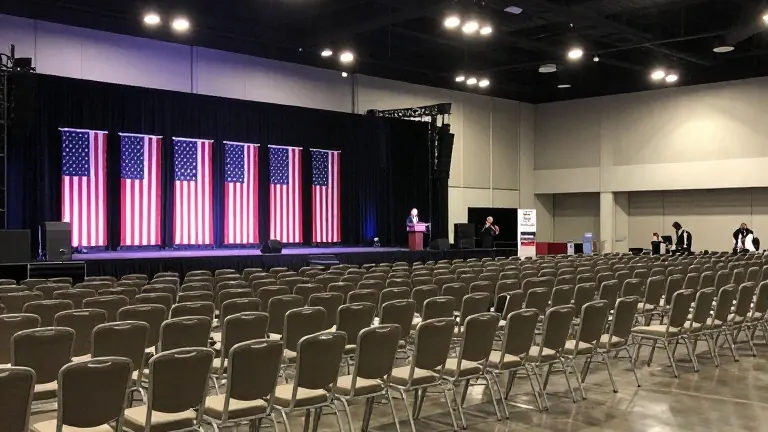
Colom addressed the historical weight of the moment during his victory speech at Tougaloo College in Jackson. He referenced Medgar Evers, the NAACP field secretary who was assassinated in 1963. "I can’t help but think about Medgar Evers on Veterans Day," Colom said. "A moment like this, where he served his country and came home to Mississippi, when they wouldn’t let him vote. But he had the faith that Mississippi could make progress. … He had faith that a day like this was possible."
Colom added, "All I did was have the courage to imagine a night like this." Rep. Bennie Thompson, a Mississippi Democrat who studied under civil rights leader Fannie Lou Hamer at Tougaloo College, introduced Colom. Thompson, who represents the state's 2nd District, said, "From my perspective, I now have a partner in Washington."
Observers noted that the victory required a coalition of voters beyond Black communities. Johnson stated that white voters also needed to be dissatisfied with the state's economy, school systems, and health care infrastructure under Republican rule. "The most important part is we’ve got to have faith that Mississippi is ready to do the right thing," Johnson told The Associated Press on Thursday. "We as a people, and Mississippi as whole, are ready to show the nation. We have to work together, and that was his message. He wants to help pull us together."
Jerome Dunn, a 59-year-old barber in Jackson who voted for Colom, echoed the sentiment of broad coalition building. "It takes everybody to vote, not one single race," Dunn said. "I think people are looking for him to work for everybody. People are tired of Republicans and what they believe."
Brian Shoup, head of political science and public administration at Mississippi State University, characterized the win as a major shift in state politics. He noted that Democrats had not won a Senate seat in the state since the 1980s, and those prior winners were traditional southern conservatives. "We haven’t had an African American senator since the era of Reconstruction, so this is obviously a very significant and important election in Mississippi history," Shoup said.
The campaign took place against the backdrop of a Supreme Court decision in late April that weakened the Voting Rights Act. That ruling contributed to a redistricting debate aimed at reducing Black representation, which in turn helped fuel increased voter turnout. Elnora Fisher, 68, of Greenville, recalled her childhood in the 1960s when her mother took her to an NAACP meeting that was interrupted by white police. "Here in Mississippi, so much has been taken from the poor people and given to the rich people," Fisher said. "I hope Colom will give back to the people who helped get him where he is."
Shoup suggested that the close nature of the race and the high turnout may allow for more open discussions about the state's past. "This race, the fact that it has been so close, and it has activated so much turnout, might portend the prospects of maybe being able to talk about these things in a more civil and open fashion," he said.