Starship Booster Falls Into Gulf, Spacecraft Aims for Tower Catch
The first stage failed to return to Starbase, but the upper stage is on track to attempt a midair capture by mechanical arms on Saturday.
By Rosa Fuentes ·
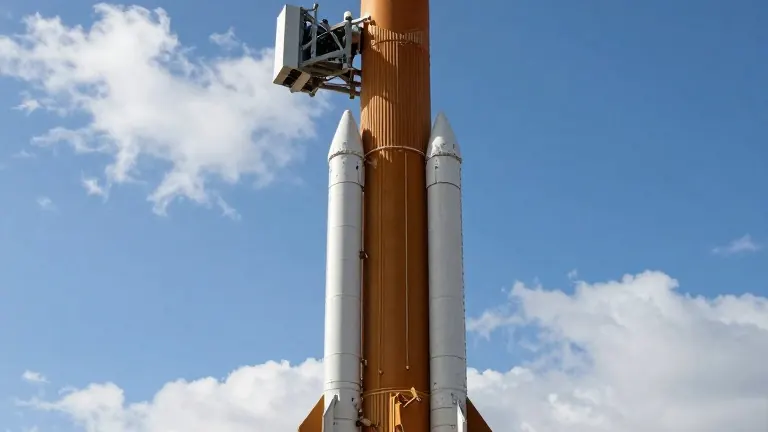
SpaceX launched its Starship rocket from Texas on Friday.
The first-stage booster did not return to the launch pad as planned.
Instead, the booster ended up in the Gulf of Mexico.
An automatic abort system triggered the change in course shortly after liftoff.
The second stage, which is the bullet-shaped spacecraft, continued its flight.
The spacecraft reached orbit despite the failure of the lower section.
The vehicle is now scheduled to steer back toward the launch tower on Saturday.
Mechanical arms on the tower are positioned to grab the spacecraft in midair.
This will be the first attempt to recover the spacecraft from orbit.
The flight is expected to last 22 hours if no further issues arise.
SpaceX aims to retrieve every part of the rocket for future use.
No other agency has achieved full rocket recovery to date. Elon Musk views this capability as essential for increasing launch frequency. He wants to support the construction of moon bases and crewed missions to Mars. The booster that failed was the upgraded production model. It measures 236 feet in height. This version is intended for lunar and Martian expeditions. The spacecraft section is 171 feet long. Together, the two stages create a rocket that stands 407 feet tall. This makes it the largest and most powerful rocket in the world. SpaceX has previously captured three earlier versions of the booster at Starbase. This is the first time the company has tried to catch the upgraded booster. It is also the first attempt to capture the spacecraft stage. In previous tests, the spacecraft sections ended up in the ocean. This occurred either by design or due to failures. During the first full-scale test in 2023, engines failed to ignite and the rocket self-destructed. The last test in September reached orbit, but SpaceX did not attempt to recover any stages. After reaching orbit on Friday, Starship prepared to deploy 26 Starlink satellites. These are the company's most advanced satellite models. The spacecraft will complete 15 laps around the Earth. It will maintain an altitude of approximately 170 miles. This orbit is about 275 kilometers above sea level. SpaceX plans to launch Starships from Florida within a few months. Launches from Louisiana are expected in a few years. Kiko Dontchev, vice president of launch at SpaceX, spoke at a NASA tech summit last week. The event was held at Kennedy Space Center in Florida. Dontchev said that scaled-up infrastructure and full reusability are the key to high launch rates. He stated that this approach allows companies to go from zero launches to 10, 100, 1,000, and eventually 100,000 launches. SpaceX will continue to use its smaller Falcon rockets for some missions. These rockets will launch astronauts to the International Space Station for NASA from Cape Canaveral. They will also launch Starlink satellites from California. Dontchev noted that Falcon rockets are not fully reusable. The company still discards the second stage on every Falcon flight. With Starship, SpaceX intends to catch both the first and second stages. NASA is paying SpaceX billions of dollars to land Artemis astronauts on the moon using Starships. Blue Origin, Jeff Bezos' company, is the other major competitor for this role. NASA expects to make a decision one year before the Artemis IV mission. Artemis IV will be the first crewed lunar landing in more than 50 years. The agency will choose between Musk's Starship and Bezos' Blue Moon for the surface landing. During the Artemis III mission next summer, astronauts will practice docking. They will dock their capsule with a Blue Moon in orbit around Earth. They will also practice docking with a Starship. These maneuvers will prepare the crew for a moon landing as early as 2028.
More Tech · Las Vegas news · Report a business · Got a Story?