Delhi's Winter Air Turns Toxic as New Rules Struggle to Hold Back the Smog
Air quality readings have already spiked, and residents are relying on purifiers and masks while the government tests a new early action plan.
By Nathaniel Hayes ·
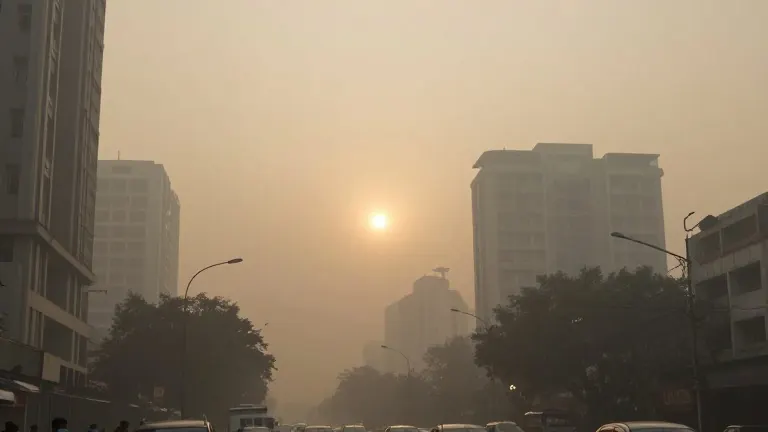
A grey haze has settled over Delhi this week, accompanied by a sharp, smoky odor that residents recognize instantly. The city’s air quality has deteriorated rapidly, causing widespread eye irritation and respiratory distress. This early onset of winter smog is testing the limits of a new government plan designed to manage the annual pollution crisis before it reaches its peak.
The Delhi government launched its Winter Action Plan on November 1, 2026. The initiative runs through February 28, 2027, covering the months when pollution typically spikes. Officials announced the measures months in advance, a departure from previous years when rules were often implemented only after air quality became critical. The plan restricts older, high-emission vehicles from entering the city and denies fuel to cars lacking valid emission certificates. It also bans dust-generating demolition and outdoor construction work temporarily.
To reduce traffic congestion, the government has encouraged private vehicle use by allowing offices to mandate remote work for half their staff. Parking fees have been doubled, and office hours for government employees have been staggered. These actions are separate from the Graded Response Action Plan, a federal framework that triggers stricter restrictions as pollution levels rise. This week, the second stage of that federal plan is active, limiting the use of diesel generators and the burning of coal and firewood.
Experts suggest the new timing is a positive step, but they warn that planning alone will not fix the problem. Parthaa Bosu, a strategic adviser at the Environmental Defense Fund, noted that execution remains a challenge. "There are a lot of positive changes as far as planning is concerned, but when it comes to execution, we probably still stand at the same level," Bosu said. He emphasized that secondary pollutants, such as dust and ash from brick kilns, are often overlooked in mitigation efforts.
Manoj Kumar, an analyst at the Centre for Research on Energy and Clean Air, argued that the city needs specific emission targets for every sector, including power generation and industry. "We know how much each sector and each state contributes to pollution. We can set targets to reduce emissions from each of them over the next five years," Kumar said. He stressed that addressing only vehicle entry and construction dust is insufficient to curb the overall pollution load.
The pollution problem is compounded by emissions from neighboring states, which travel into Delhi and worsen air quality. Government monitoring stations frequently record Air Quality Index readings above 300 during winter, a level classified as very poor. On severe days, readings can hit 500, the maximum on the domestic scale. International trackers have recorded figures near 1,000. The World Health Organization recommends 24-hour average PM2.5 levels stay below 15 micrograms per cubic meter, but Delhi often exceeds that limit by more than 25 times during the season.
Health officials warn that these tiny particles penetrate deep into the lungs and enter the bloodstream. Dr. Manoj Goel, head of the pulmonology unit at Fortis Memorial Research Institute, explained that this triggers inflammation and affects multiple organs. A 2025 report by the Energy Policy Institute at the University of Chicago estimated that air pollution could reduce life expectancy in Delhi by up to 8.2 years. Commuters face additional strain as long queues form at city borders where vehicles are checked, leaving many stuck in traffic for hours.
Meenu Rana, a 43-year-old teacher, keeps her windows closed and has added more air purifiers to her home. She said she would have left the city if possible, but her family’s jobs and her son’s school make moving difficult. "What option do we have? It is unfair but we will have to live with it," Rana said.