Hawaiian bird drills using whole body
A new study reveals how the 'akiapōlāʻau uses a large ankle tendon to power its unique wood-boring behavior.
By Nathaniel Hayes ·
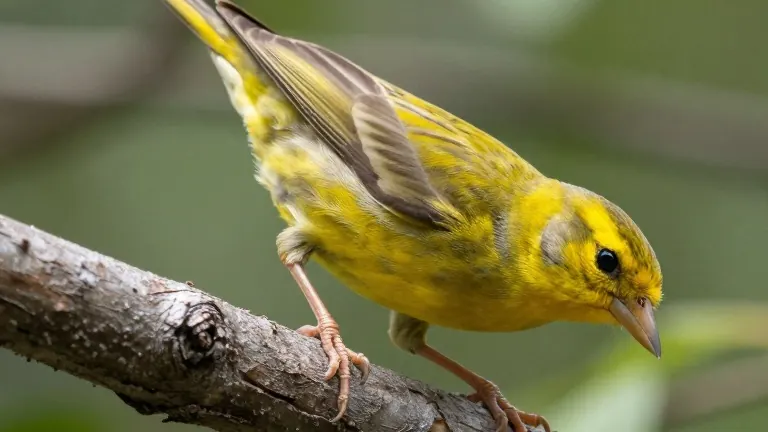
Researchers have identified the specific anatomical mechanism that allows the endangered 'akiapōlāʻau to drill into wood for food. The bird does not rely on neck muscles like a woodpecker. Instead, it uses a large tendon in its ankle to drive its entire body downward with force.
This discovery resolves a long-standing question about how the bird survives while using its distinct bill. The 'akiapōlāʻau, also known as Aki, is native to the northeastern slope of a single mountain in the Hawaiian Islands. The study utilized data from the Field Museum of Natural History in Chicago.
The bird's bill functions as two separate tools. The upper mandible is long, narrow, and flexible, allowing it to probe for grubs in crevices. The lower mandible is short and broad, designed for boring into wood. This configuration is unique among birds and has no close equivalent in other ecosystems.
Alexander Clark, a Ph.D. candidate at the University of Chicago and lead author of the study, explained the mechanics of the movement. He compared the action to swinging an axe. The bird bends its ankles upward to store energy before releasing it to pound into the wood. It anchors itself to the branch while doing so.
Scientists previously knew the bird performed these actions but lacked detailed anatomical evidence of how its body facilitated the movements. Clark noted that the team now has a clear understanding of the physical process.
Paul Banko, a co-author of the study and former researcher at the USGS Pacific Island Ecosystems Research Center, said the bird's evolution was driven by intense competition. When Oahu emerged from the water, a large number of animal species appeared. These species competed for limited resources such as caterpillars to feed their young.
The findings arrive at a critical time for the species. Experts estimate that fewer than 2,000 'akiapōlāʻau remain in the wild. The study highlights the unique evolutionary path of a bird found on only one mountain in Hawaii.