South Korean Adoptees Demand Record Access and DNA Expansion at Seoul Protest
Activists urge the government to streamline family searches and investigate historical fraud as officials weigh shifting oversight to the Foreign Ministry.
By Vincent Parker ·
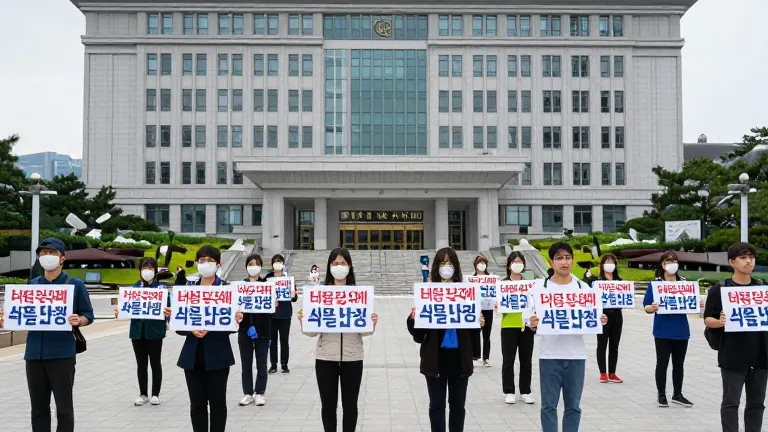
Hundreds of adoptees from Western nations gathered outside the presidential office in Seoul on Friday to demand immediate access to their original adoption files and expanded DNA matching services. The demonstration coincided with a review of post-adoption policies by the administration of President Lee Jae Myung, which is considering a major restructuring of how birth-family searches are managed.
A coalition of nine adoptee organizations from Europe and the United States, joined by South Korean human rights advocates, issued a joint statement calling for broader access to administrative and residential records. The groups also requested new investigations into the manipulation of adoption documents and wrongful child-parent separations that characterized the country's historic adoption program. They urged the government to establish clearer paths for reparations for adoptees and their relatives affected by widespread fraud.
The protest follows a gathering of hundreds of Korean adoptees in Seoul the previous week. Officials are currently evaluating whether to shift primary responsibility for adoptee services from the National Center for the Rights of the Child, which operates under the Health and Welfare Ministry, to the Overseas Korean Agency under the Foreign Ministry. Proponents argue the latter is better positioned to coordinate with Western nations that received Korean children, though the transition may require new legislation.
Legislative efforts are also underway to modify privacy laws. Multiple bills are under debate that would allow adoptees to obtain information about their birth parents unless those parents explicitly request confidentiality. This approach aims to overcome bureaucratic barriers that have historically slowed down family reunification efforts.
The push for reform builds on findings from South Korea’s Truth and Reconciliation Commission, which concluded in 2025 that the government bears responsibility for an adoption program driven by efforts to reduce welfare costs. The commission’s findings aligned with earlier reporting indicating that the program was rife with fraud and abuse. President Lee apologized to adoptees and their families following the report, describing his feelings as "heavy-hearted" over their suffering and urging officials to improve support for their search efforts.
Activists stated that a year has passed since the presidential apology without meaningful action. Kee Soon Jager, who was adopted to Germany in 1976 at age four and has searched for her biological parents since 1991, noted that time is critical. "They should do something to help us to find our families because time is running out and our parents (may have) passed away," Jager said.
Angelika Lindgren, adopted to Sweden in 1974 and listed in records as an abandoned child, called for a larger DNA database to compensate for unreliable paper documents. "I understand it’s difficult for mothers and fathers who gave up their children and I know it wasn’t always their choice," Lindgren said. "Maybe it was … an uncle who left the babies and maybe the parents didn’t even know."
Since the 1950s, approximately 200,000 South Koreans were adopted to the United States, Europe, and Australia. During the peak years of the 1970s and 1980s, thousands of children were falsely registered as abandoned to meet eligibility requirements for Western adoption laws, despite having known relatives. Private agencies paid hospitals and orphanages for children and sometimes swapped identities to maintain adoption timelines when a child died or was reclaimed by birth relatives. Western governments often overlooked signs of this fraud while seeking to meet domestic demand for adoptable children.
Health Ministry data shows that only 622 of the 11,300 family search requests submitted between 2021 and September 2025 resulted in reunions. In more than 4,600 cases, officials could not locate birth parents or determine their consent to be connected. Health Ministry officials have expressed reservations about the proposed legislative changes, warning that guaranteed access to birth-family information could infringe on privacy rights.
More Business · Unethical Practices · Report a business · Got a Story?