Newport Beach and San Pedro hit record high tides amid strong El Niño
Sea levels in Southern California reached historic highs Monday, with temperatures off the coast running nearly 10 degrees above average.
By Vincent Parker ·
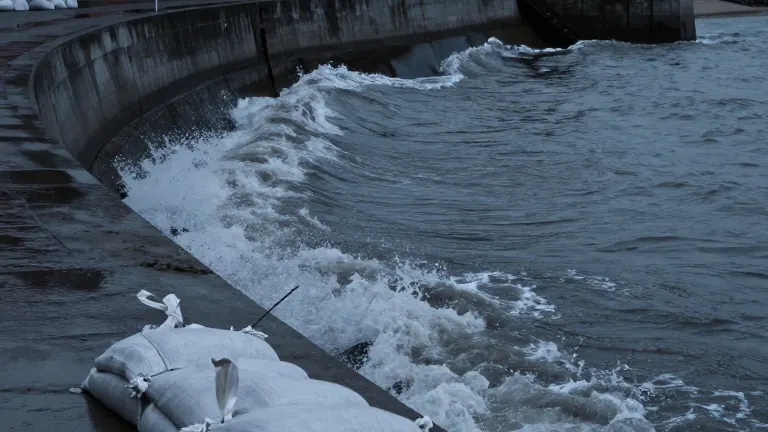
Water poured into business districts in Newport Beach and flooded sections of Pacific Coast Highway in Sunset Beach on Monday morning as high tides hit record levels. In San Pedro, sea water levels reached 8.02 feet above the baseline, surpassing the previous record of 7.93 feet set during the 2005 El Niño. Officials expect conditions to worsen on Tuesday as the region continues to experience extreme coastal flooding.
Scientists attribute the surge to record-hot ocean temperatures driven by a powerful El Niño. Warm water expands, increasing sea levels beyond what astronomical tides alone would produce. Daniel Swain, a climate scientist with UC Agricultural and Natural Resources, said waters from the Farallon Islands to Baja California are at record-warm levels for this time of year. He noted that thermal expansion is contributing to a sea level elevation comparable to or greater than any previously observed.
The current El Niño is intensifying the warm waters that have persisted off Southern California all year. Reinhard Flick, a researcher at the Scripps Institution of Oceanography, reported that sea surface temperatures at Scripps Pier in La Jolla reached 73.8 degrees Fahrenheit on Monday, which is 9.1 degrees above the average for that calendar day. Flick stated that the El Niño is keeping the water warm, preventing the natural seasonal drop in temperature. NASA climate scientist Josh Willis described the event as potentially as large as the 1997 El Niño, which caused trillions of dollars in global damage, noting that sea levels are also higher due to two decades of climate change since that event.
David Gomberg, a meteorologist with the National Weather Service in Oxnard, explained that the 8.02-foot reading in San Pedro was 1.42 feet higher than predicted by the positions of the moon, Earth, and sun. He cited thermal expansion from warmer coastal waters and a Kelvin wave as contributing factors. The Kelvin wave, which moves warm water from the equatorial Pacific along the coast, arrived earlier in October. Its arrival, combined with swells from Tropical Storm Rachel, caused significant flooding in Long Beach and Newport Beach earlier this month.
Residents in Long Beach reported flooding along Bayshore Beach, Naples, and the peninsula. Nancy Pinckert, a Naples resident, recorded video showing water leaking through the base of a seawall onto a walkway. She expressed concern that the aging seawalls are under profound stress and warned that the king tides expected in November and December could breach them for the first time. Swain added that much of the California coast is 5 to 9 degrees Fahrenheit warmer than average, a difference he described as enormous for the local ecology.
The region is also approaching peaks in the 18.6-year lunar node and 4.4-year lunar perigee tidal cycles, which are expected to produce higher tides around the Thanksgiving, Christmas, and Martin Luther King Jr. Day holidays. Mark Merrifield, director of UC San Diego’s Center for Climate Change Impacts and Adaptation, had warned months ago that the strengthening El Niño would likely bring the highest sea levels ever recorded on the California coast. The flooding arrived earlier than anticipated, following an active hurricane season that included remnants of Hurricane Marie, which flooded homes in Dana Point and Long Beach over Labor Day weekend.
A sinkhole opened in the driveway of actor Nicolas Cage’s Malibu home, forcing evacuation orders for dozens of nearby residences. The series of events confirms the predictions made by climate experts regarding the severity of this winter’s coastal conditions.
Source: Los Angeles Times · original report published
More News · Las Vegas news · Report a business · Got a Story?