Union Canvassers Report Persuading Reluctant Henderson Voter to Return to Ballot
Culinary Workers Union Local 226 members knocked on 900,000 doors in 2024, a strategy that research suggests reduces partisan hostility.
By Mariam Saleh ·
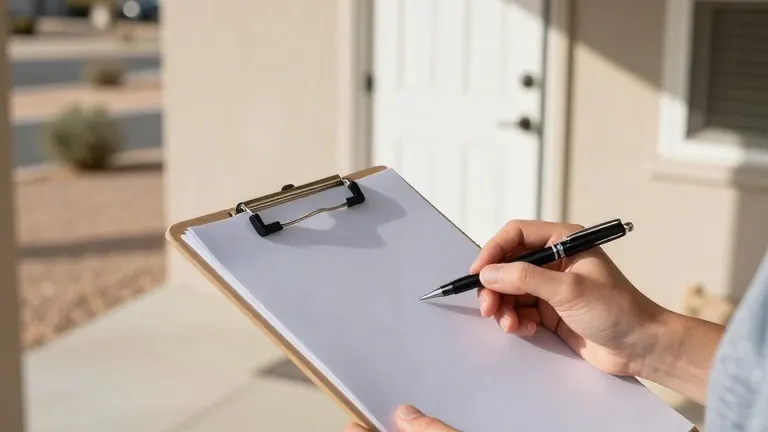
Betty Snowden opened the front door of her Henderson home despite no-soliciting signs posted in her yard. Standing on her porch were Jessie Garduno and Nataly Rocha, canvassers for Culinary Workers Union Local 226. The two women were campaigning for Democratic Attorney General Aaron Ford, who is seeking the governorship, and U.S. Rep. Dina Titus, who is running for reelection in Nevada’s 1st Congressional District.
Snowden, a retired nurse, told the canvassers she had voted for President Donald Trump in previous cycles and initially did not plan to vote in the upcoming election. She explained that she dislikes being categorized by party affiliation but cited concerns about education affordability and student loan interest rates.
“I think with education, they shouldn’t charge any interest,” Snowden said. “Interest kills those kids.”
The conversation on the porch continued for approximately 20 minutes. By the end of the exchange, the canvassers hugged Snowden, and she agreed to vote. Snowden stated that the canvassers listened to her concerns and presented their own viewpoints. “I wasn’t going to, but I will now,” she said.
Hundreds of Culinary Union members conduct similar door-to-door outreach during election years. Union leaders reported that members knocked on more than 900,000 doors in 2024. Other political groups are also active in the Las Vegas Valley. The campaign for Gov. Joe Lombardo recorded 50,000 doors knocked in the week leading up to the current reporting period.
Roxanne Perez-Guzman, a Culinary member canvassing for Assembly District 35 candidate Joe Spica, said the work connects her with neighbors beyond political outcomes. She described the activity as similar to customer service work and suggested everyone try it once to understand how residents in their area live.
Perez-Guzman said the conversations taught her about her own street, including the presence of children and parents' concerns about speeding vehicles. She now leaves snacks and water for the kids in her neighborhood. “How we can be better neighbors, better friends, better family members,” she said.
A study by David Broockman, a professor at the University of California, Berkeley, and Joshua Kalla, a doctoral student at Berkeley at the time, found that voter conversations at the door and by phone reduced canvassers' hostility toward the opposing party in the days and weeks following the interactions. The research indicates that the act of canvassing can alter the attitudes of the people doing the knocking.
Sondra Cosgrove, a history professor at the College of Southern Nevada, expressed skepticism about the effectiveness of canvassing. She noted that gated communities are becoming more common, limiting available canvassing areas. Cosgrove also questioned whether door knocking increases long-term political involvement, suggesting that some residents open the door only because they wish to talk, while others do so out of reluctance.
Cosgrove proposed grassroots discussions where residents present different narratives and work toward solutions as an alternative to door knocking. She said such spaces would help engage her students. “We just maybe start having some spaces where we’re just going to evaluate different plans,” Cosgrove said. Perez-Guzman acknowledged that some voters feel intimidated by political canvassers but said she listens to their issues and takes those conversations home to process.
More Politics · Las Vegas news · Report a business · Got a Story?